Architecture &
decoupling
Optional AI in arsnova.eu
while keeping live operations
responsive
Thema 1 · 1A / 1B / 1C
Cloud Computing · evidence: 13
November 2026
Research question and scope
How can arsnova.eu stay responsive with optional AI?
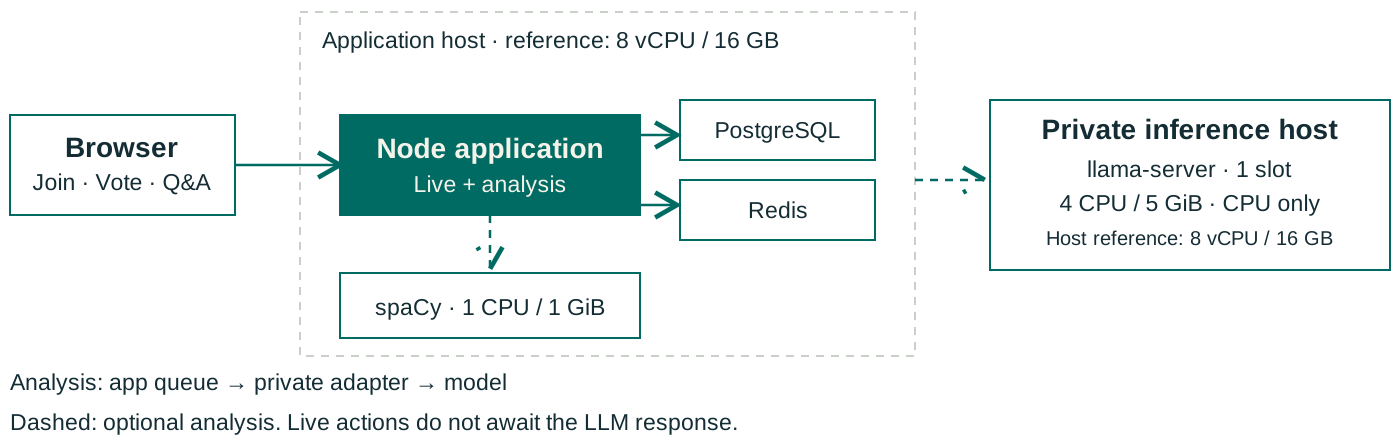
Application-host resources
Bound spaCy resources; measure latency and rejections under the same offered load.
Separate private inference server
Separate model execution; check private targets, access and occupied slots.
Authorized context and asynchronous adapter
Prepare authorized sources; process in the background; revalidate before delivery.
Reference architecture boundaries
Live actions and optional analysis follow different execution paths.
Experimental setup and evidence
One unchanged baseline; two separate laboratory setups.
1A · Local resources
ARM64 Docker VM: 10 logical CPUs, about 7.65 GiB RAM.
Backend: 4 CPU / 3 GiB. spaCy shares the VM host.
1B / 1C · Genuine inference
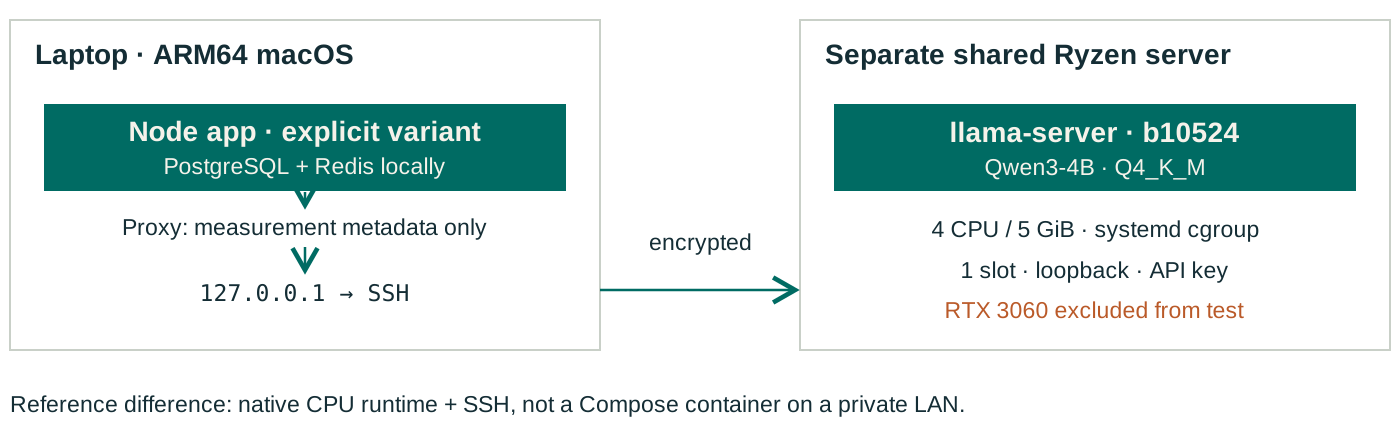
Laptop application → separate shared Ryzen server.
CPU runtime: 4 CPU / 5 GiB, 1 slot. RTX 3060 excluded.
Source inspection ≠ mock test ≠ real model run. Neither lab matches the reference hardware.
1A · Repeatable resource comparison
Same question corpus and offered load across nine valid runs.
spaCy off
Identity tokens instead of lemmatization.
1 CPU / 1 GiB
Normal NLP sidecar budget.
0.25 CPU / 1 GiB
CPU constrained; memory unchanged.
Per run
100 fixed questions
30 analyses · 1 request/s
720
quiz votes
54 joins · 24 Q&A submits
3 repeats per condition; counterbalanced order. Models warm, text/snapshot caches cold.
1A · Live latency under the tested load
All nine runs met the proposed local latency gates.
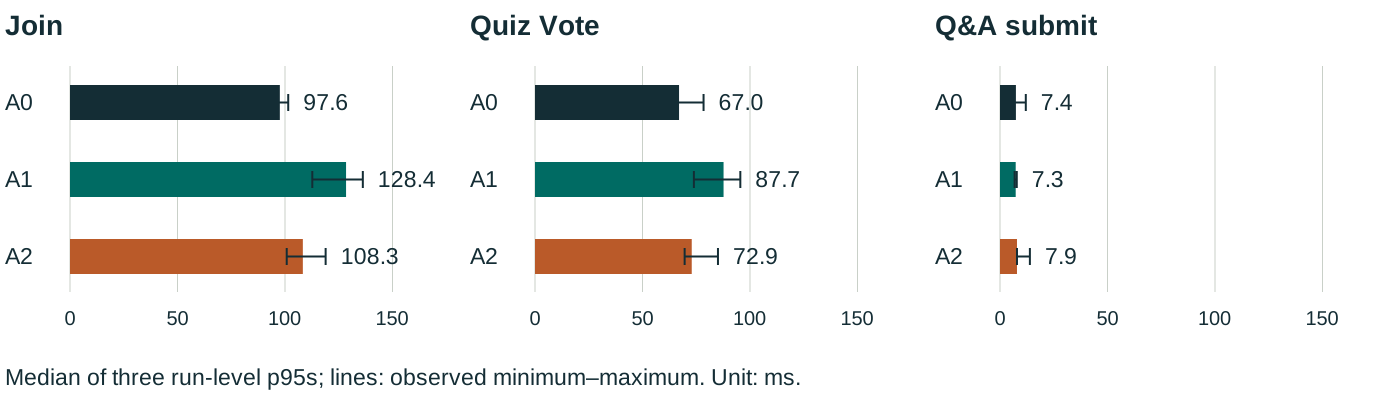
Local gates: vote p95 ≤ 250 ms; join/submit p95 ≤ 500 ms. These are not official production SLOs.
1A · Less CPU delays analysis
At 0.25 CPU, accepted requests take longer and busy rejections appear.
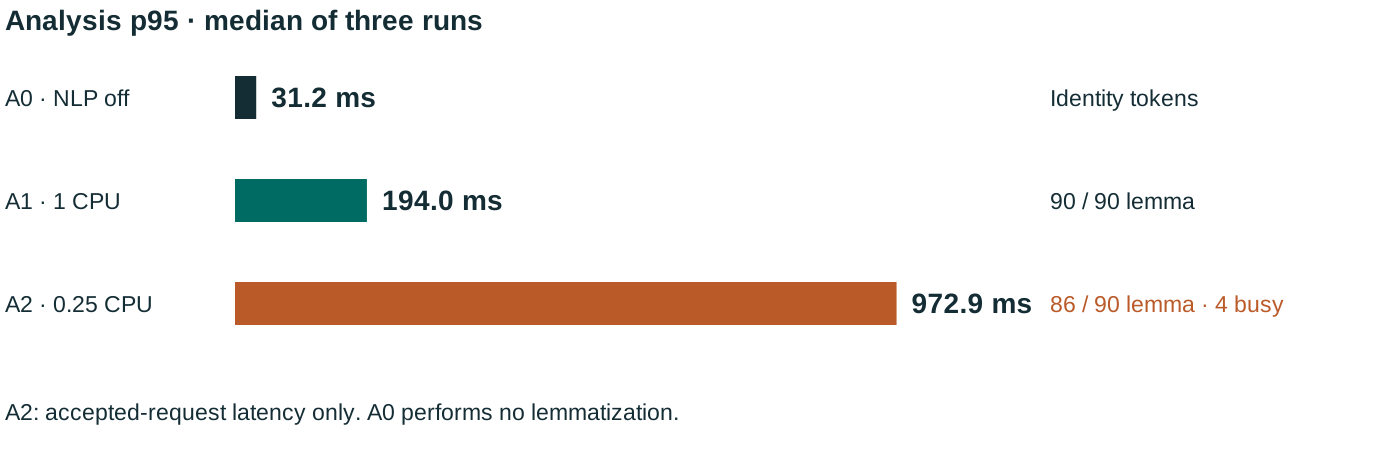
Retain 1 CPU / 1 GiB for this load profile. Disabling NLP is a functional alternative with different linguistic output.
1B · Measured inference deployment
Private access to a separate CPU process; existing GPU unused.
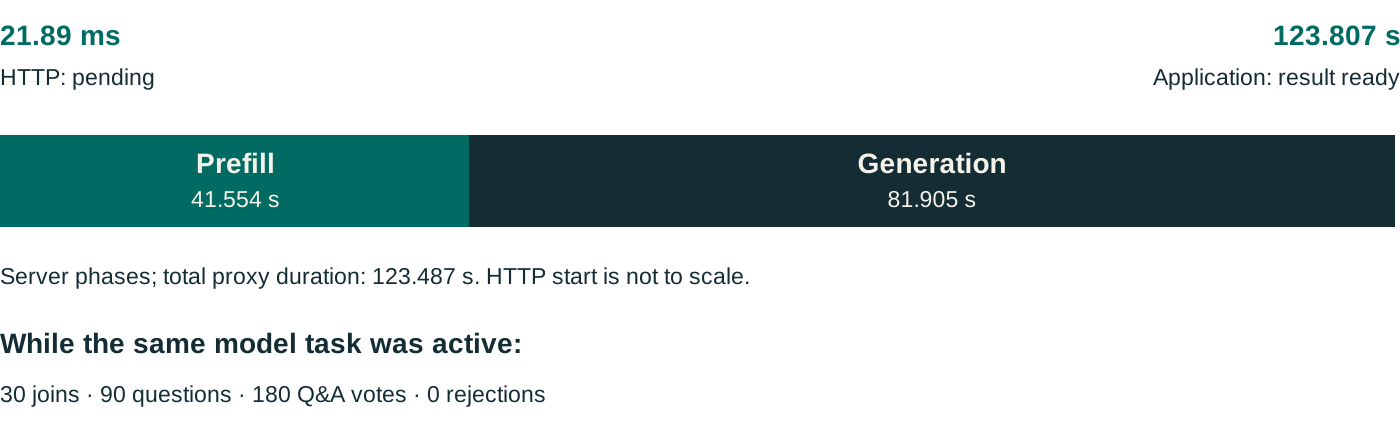
1B · Long inference with concurrent live Q&A
The explicit variant delivered six source-bound statements after about two minutes.
1C · Authorized context and background work
pending precedes the model result, but follows initial context preparation.
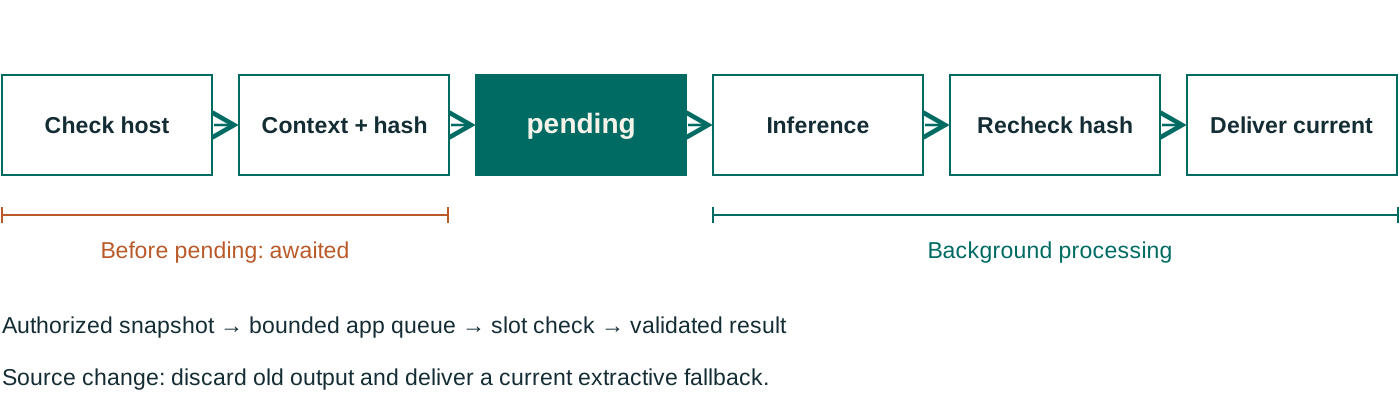
The bounded application queue and occupied model slot are separate admission boundaries.
1C · Source deletion during inference
An expensive old result must not override the current source state.
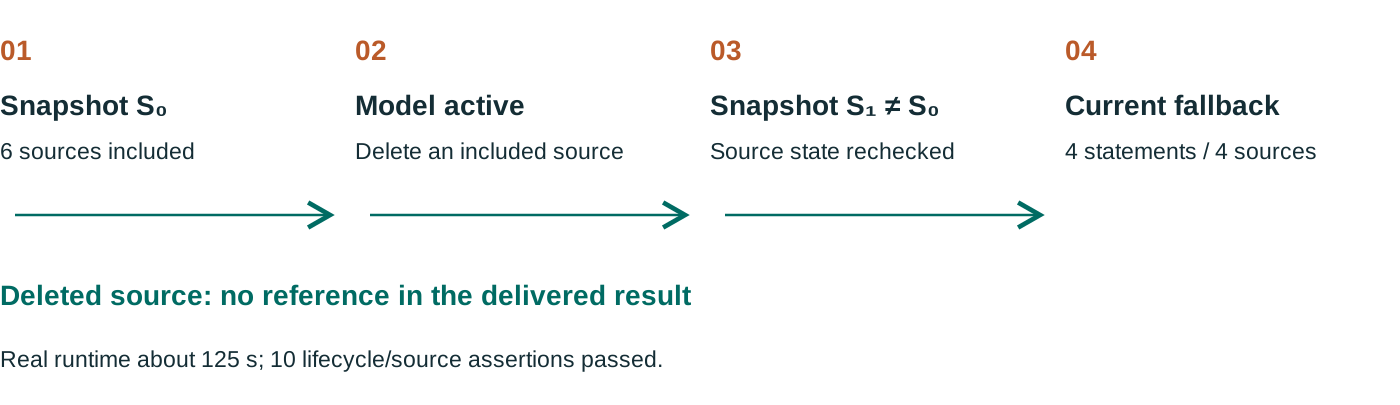
Baseline and explicit experiment
A successful lifecycle does not yet mean a useful generative summary.
| Unchanged baseline | Explicit experiment | |
|---|---|---|
| Packing profile | 4096 | 8192 |
| Summary timeout | 8 s | 180 s |
| Represented sources | 0 / 6 | 6 / 6 |
| Genuine terminal result | Timeout fallback · 0 statements | full-context · 6 statements |
| Time to terminal result | about 8.23 s | 123.807 s |
The 4096 packer uses a conservative UTF-8 byte upper bound, not measured model-token counts.
Validity limits and next measurements
The findings support a lab decision; they do not establish production capacity.
Different hardware and topologyARM64 VM and shared Ryzen host; SSH instead of a direct private LAN.
Limited repetition1A: three runs per condition. 1B/1C: targeted genuine checks, no capacity study.
Quality remains openSchema and source IDs do not establish semantic correctness.
Next controlled experimentCompare idle/active/constrained/failed inference; measure real slot release after abort.
Operating decision
Provisional recommendation for the profiles actually tested.
Keep spaCy at 1 CPU / 1 GiB
With less CPU, revisit request cadence or the accepted delay.
Keep private inference and source revalidation
Keep live actions independent of model completion; discard stale output.
Keep the generative feature disabled for now
Justify context, freshness and quality before adopting the variant.
Appendix · 1A in detail
Run-level p95 in ms: median of three repeats; parentheses show min–max.
| Condition | Join | Quiz Vote | Q&A submit | Analysis | Lemma / busy |
|---|---|---|---|---|---|
| A0 | 97.6 (96.6–101.5) | 67.0 (64.0–78.4) | 7.4 (6.3–12.0) | 31.2 (26.3–39.4) | 0 / 0 |
| A1 | 128.4 (112.7–136.2) | 87.7 (73.9–95.5) | 7.3 (6.8–7.8) | 194.0 (193.9–206.3) | 90 / 0 |
| A2 | 108.3 (100.8–118.9) | 72.9 (69.6–85.1) | 7.9 (7.9–13.9) | 972.9 (886.5–1057.5) | 86 / 4 |
Per condition: 2,160 quiz votes, 162 joins, 72 Q&A submits. No live vote/submit errors.
Sampled RAM: app max. 478.5 MiB; spaCy max. 486.7 MiB. No OOMs or restarts during measurement.
Invalid token-expiry run replaced in full; original report retained.
Appendix · Reproducibility and sources
Code, configuration and raw reports form the evidence together.
Release source and ADR-0035v1.3.0 ·
87c39334619fbcb0c5782b061da1ba0df0ba3142
1A protocol, raw data and tableFixed corpus · cold text caches · counterbalanced order
1B/1C runtime and genuine model reportsllama.cpp b10524 · Qwen3-4B-Instruct-2507-Q4_K_M.gguf
Explicit patch and limitations8192 packing + 180-s timeout; no production approval
Appendix · AI assistance and student review
Assistance is disclosed; the technical defense requires independent understanding.
Created with Codex
Planning, source inspection, harnesses, analysis and the draft of these slides.
Title illustration with Image Gen. Diagrams and charts use documented flows and measured data.
Review before submission
Read the evidence, explain the variants and justify the limits of each claim.
Confirm course commit and formal requirements. Do not claim independent measurement design without disclosing the assistance.
All measurement figures used are observed lab values. The AI-generated illustration is not a photograph of the experiment.